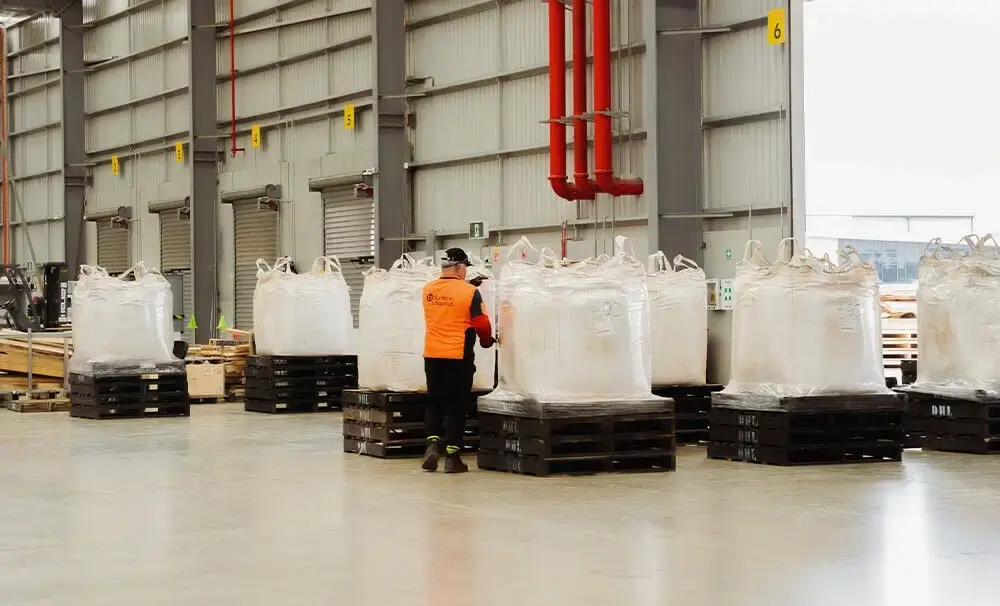
A practical guide for Australian retailers and wholesalers on building a fulfilment operation that controls freight cost, protects delivery reliability and scales from small parcels to oversized goods.
Australian shoppers spent a record $82.6 billion online in 2025, up 14% on the year before, and online purchases now make up almost a quarter of all retail spending, according to the Australia Post eCommerce Report 2026. Yet the average basket has slipped to around $96, and households now buy from roughly 16 different retailers a year. More orders, smaller baskets and rising delivery expectations put one part of the business under real strain: fulfilment.
Multi carrier fulfilment is how a modern 3rd party logistics (3PL) provider keeps that strain in check. Rather than pushing every order through a single delivery partner, the provider builds a network of carriers and matches each consignment to the option that moves it most efficiently. Done well, it lowers freight cost, widens delivery coverage and keeps promises to customers. Done poorly, it quietly erodes margin on every parcel that leaves the warehouse.
Here is how 3PL services are structured for multi carrier fulfilment in Australia, and what to look for when you decide to outsource it.
» MORE: What 3PL services cover
What is multi carrier fulfilment?
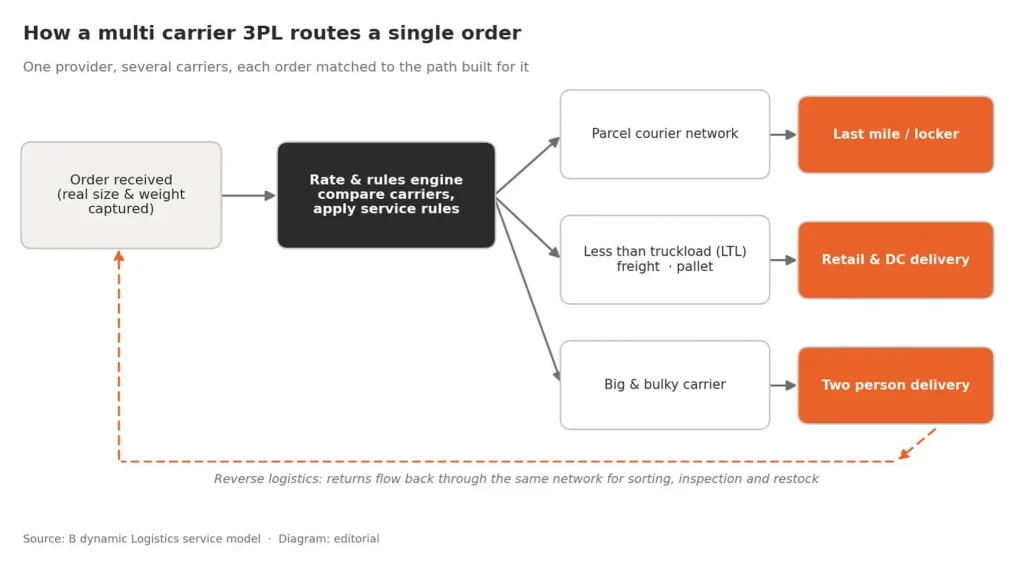
A structured multi carrier model matches every order to the carrier built for its size, weight and destination.
Multi carrier fulfilment is a logistics model where a single 3PL provider ships orders through several delivery carriers rather than relying on one. The provider holds contracts and system integrations with a mix of parcel couriers, freight lines and specialist operators, then selects the right carrier for each order based on its size, weight, destination and service level.
The logic is simple. No single carrier is the cheapest or fastest for every order. A small parcel to a Sydney metro address, a pallet of stock to a regional distribution centre and a 200 kilogram appliance to a rural home are three different delivery problems. A single carrier forces all three down one pricing model. A structured multi carrier network sends each one down the path built for it.
Two factors shape the model more than any other: product type and sales channel. A business shipping light online orders has very different needs from a wholesaler moving palletised freight or a furniture brand handling oversized goods. Strong 3PL services are structured around those differences rather than against them, which is why ecommerce fulfilment, B2B freight and big and bulky delivery usually run as distinct but connected streams.
Why a multi carrier network matters for Australian sellers
Australia is a large, low density market. Long distances between capital cities, a thin regional population and clusters of demand along the eastern seaboard make delivery unusually expensive and unusually variable. Regional online shopping has also been growing faster than metro in many categories, with areas such as Toowoomba and Mackay ranking among the top postcodes for online shopping volume in recent Australia Post reports. Peak events concentrate demand even further, with the 2025 Black Friday and Cyber Monday weekend alone generating $1.5 billion in online spend, according to Australia Post.
That combination rewards a network approach. A structured multi carrier operation gives an Australian seller three practical advantages:
- Cost control. The provider can compare carrier rates and route each order to the most economical option for its weight, size and lane.
- Coverage. Metro couriers, interstate freight lines and regional operators each reach different ground. Together they cover far more of the country reliably than any single carrier can.
- Resilience. When one carrier hits delays, industrial action or a peak season backlog, orders shift to an alternative rather than stalling.
For sellers scaling nationally, a provider such as B dynamic Logistics, which operates across Sydney, Melbourne, Brisbane, Adelaide and Perth and into New Zealand, structures this network so that growth does not mean renegotiating delivery from scratch in every new state.
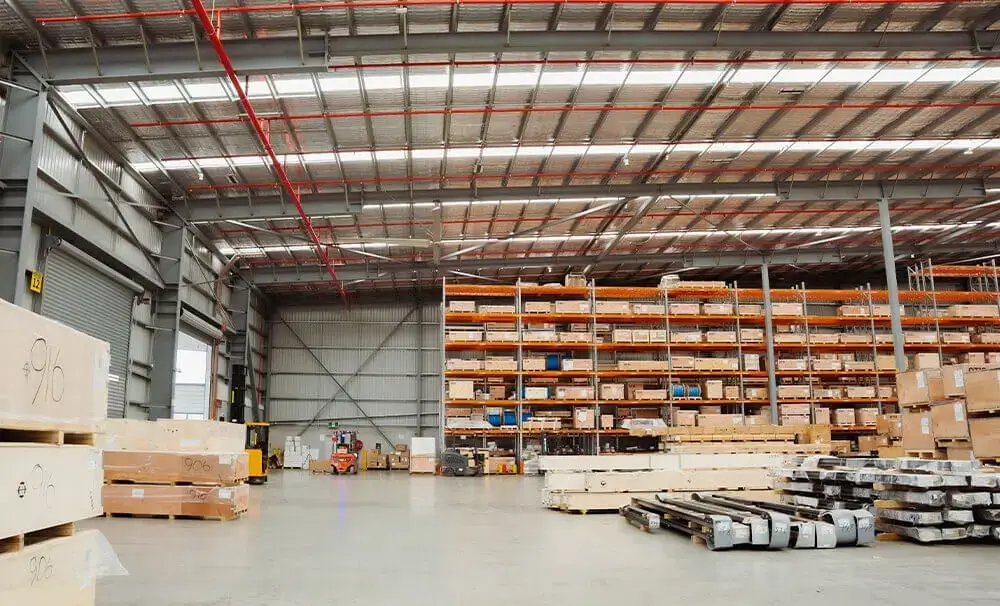
How a 3PL structures the carrier mix: parcel, LTL and full freight
At the centre of any multi carrier operation sits a single decision: which carrier should move this order? Providers structure the answer around freight tiers, each suited to a different size and weight of consignment.
| Freight tier | Typical consignment | Best for | Example goods |
| Parcel | Small, light satchels and cartons | Online orders to homes and lockers | Apparel, cosmetics, books |
| Less than truckload (LTL) freight | Palletised, part load | B2B stock and larger orders | Cartoned stock, retail replenishment |
| Full load freight | Whole vehicle by road, rail, air or sea | Warehouse and port movements | Container volumes, interstate transfers |
| Big and bulky | Oversized, heavy or awkward | Furniture, appliances, equipment | Lounges, treadmills, whitegoods |
Table: the four freight tiers a multi carrier 3PL routes across.
Here is how a capable 3PL allocates an order across that mix:
- Capture the order and its real dimensions and weight at the warehouse.
- Compare carrier rates and service levels for that exact size, weight and destination.
- Apply business rules, such as guaranteed delivery windows or preferred carriers for certain regions.
- Select the carrier that meets the service promise at the lowest cost.
- Generate the label, book the pickup and pass tracking back to the seller and the customer.
B dynamic Logistics builds this into its Transportation – Multi Carrier Solutions service, moving freight by road, rail, air and sea with real time tracking and visibility across the whole journey.
» MORE: Transportation and multi carrier solutions
Cubic weight: the number that decides what you pay
If there is one technical detail every Australian seller should understand before outsourcing fulfilment, it is cubic weight. It is the biggest reason two consignments of the same actual weight can cost very different amounts to ship.
Carriers charge on the greater of two figures: the actual weight of a consignment, sometimes called deadweight, and its cubic weight, a calculated figure that reflects the space it takes up on the vehicle. Low density goods such as furniture, packaging or flat packed items almost always bill on cubic weight, because they occupy far more room than they weigh.
The formula used across most Australian road freight is straightforward:
Length (m) × Width (m) × Height (m) = cubic metres
Cubic metres × conversion factor = cubic weight in kilograms
Domestic road freight most commonly applies a conversion factor of 250 kilograms per cubic metre, the standard Australia Post and many carriers use. Some contracts use 333 kilograms, and air freight sits closer to 167. The factor is not a law of physics. It is a commercial term printed on your rate card, and one of the first things worth checking.
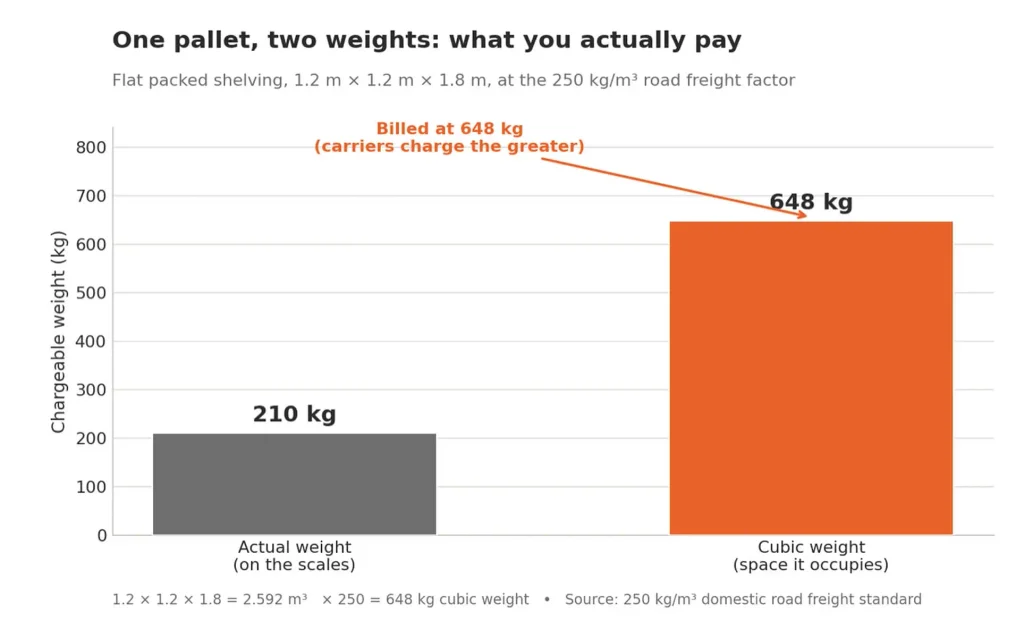
The same pallet can bill at three times its scale weight once cubic weight is applied.
| Worked example: one pallet of flat packed shelving | |
| Dimensions | 1.2 m × 1.2 m × 1.8 m |
| Cubic volume | 2.592 m³ |
| Conversion factor | 250 kg per m³ (domestic road freight) |
| Cubic weight | 648 kg |
| Actual weight (deadweight) | 210 kg |
| Charged weight (the greater) | 648 kg |
Take that pallet of flat packed shelving measuring 1.2 metres by 1.2 metres and stacked to 1.8 metres, weighing 210 kilograms on the dock. Its cubic weight works out at 648 kilograms, so the carrier bills the greater figure and the consignment prices as 648 kilograms. You are paying for more than 400 kilograms that never touched the scales. That is not an error. It is deadweight versus cubic weight working exactly as intended.
This is why warehousing and packaging decisions sit at the heart of fulfilment cost. A 3PL that structures storage, cartonisation and pallet building around cubic weight can strip chargeable weight off your freight bill without changing a single rate. That is the real job of a warehousing operation and correctly sized packaging: not just to hold stock, but to protect margin.
» MORE: How freight surcharges are calculated for cubic weight and oversized goods
Handling big and bulky freight
Oversized goods break the standard parcel and pallet model. A treadmill, a wardrobe or a commercial oven cannot travel through a courier network or arrive on a doorstep with one driver. Structuring a 3PL for these items means investing in two things: the right equipment and the right delivery method.
- Material handling equipment. Forklifts, cranes and specialised trucks and trailers move heavy and awkward stock safely through the warehouse and onto vehicles. Without this equipment, big and bulky goods cannot be stored or loaded without risk of damage or injury.
- Two person delivery. Heavy or large items delivered to a home or business often need two people to carry, position and sometimes assemble them. Two person delivery protects the goods, the property and the customer, and it is a core part of oversized fulfilment.
B dynamic Logistics handles this through its Big and Bulky Fulfilment service, supported by Specialised Machinery and Equipment for the safe storage and movement of large items. For furniture, appliance, fitness and homewares brands, this tier is often the difference between a delivery that builds loyalty and one that generates a complaint and a return.
» MORE: Big and bulky logistics solutions
Reverse logistics and delivery visibility
A fulfilment operation is not finished when the parcel leaves the warehouse. Two capabilities decide whether the model holds together from end to end: returns and visibility.
Reverse logistics is the process of moving goods back from the customer, whether for returns, exchanges, repairs or recycling. In a multi carrier model this is more complex, because returns can arrive through several carriers and still need sorting, inspection and restocking. Returns are among the biggest hidden costs in online retail, and a slow or confusing returns process is one of the fastest ways to lose a repeat customer. A structured reverse logistics function turns that risk into a chance to retain them.
Real time tracking and visibility ties the network together. When a seller runs several carriers, a single view of every order matters more, not less. Good 3PL services consolidate tracking across carriers so the seller and the customer see one status, whichever carrier is actually moving the goods. A provider that offers reverse logistics as a shared service, paired with last mile delivery and one tracking view, keeps returns and deliveries running through a single connected system rather than a patchwork of carrier portals. B dynamic Logistics backs this with the BDL Advantage platform and dedicated account contacts.
How to choose a 3PL for multi carrier fulfilment
Not every provider structures multi carrier fulfilment the same way. When you assess 3PL services in Australia, work through this checklist:
- Carrier range. Ask how many carriers the provider integrates, and across which tiers, from parcel to LTL freight to big and bulky.
- Rate logic. Confirm how orders are allocated, and whether the provider rate shops on cubic weight rather than actual weight alone.
- Coverage. Check metro and regional reach across the states you sell into, plus New Zealand if you trade across the Tasman.
- Technology. Look for real time tracking, a single dashboard and integration with your ecommerce or ERP systems.
- Specialist capability. If you ship oversized goods, confirm that material handling equipment and two person delivery are in place.
- Returns. Ask how reverse logistics is handled across carriers, and how quickly stock is inspected and restocked.
A provider that answers these clearly is genuinely structured for fulfilment. One that cannot is often reselling a single carrier under a logistics label. B dynamic Logistics is built to answer them, with multi-state stock positioning and a cross-sector operating model behind its freight network.
The bottom line
Multi carrier fulfilment is not about using more carriers for their own sake. It is about structuring 3PL services so each order travels the path built for its size, weight and destination, at the lowest sensible cost and with a delivery experience customers trust. For Australian sellers facing rising order volumes, shrinking baskets and a demanding delivery market, that structure is where margin is won or lost.
If you are weighing up a fulfilment partner, B dynamic Logistics can map your freight profile and show how a structured multi carrier model would apply to your products and channels, with pricing based on your actual order volumes.
Frequently asked questions
Q1: What is multi carrier fulfilment in a 3PL context?
It is a model where one 3PL provider ships your orders through several delivery carriers instead of one, matching each order to the carrier that best suits its size, weight, destination and service level. The aim is lower freight cost and wider, more reliable coverage.
Q2: How does a 3PL decide which carrier ships each order?
The provider captures the order’s real dimensions and weight, compares carrier rates and service levels for that size and destination, applies any business rules such as delivery windows, then books the carrier that meets the promise at the lowest cost.
Q3: What is cubic weight and how does it affect my shipping cost in Australia?
Cubic weight is a calculated figure based on the space a consignment occupies rather than what it weighs. Carriers bill the greater of actual weight and cubic weight, so light but bulky goods often cost far more to ship than the scales suggest.
Q4: What conversion factor do Australian carriers use for cubic weight?
Domestic road freight most commonly uses 250 kilograms per cubic metre, the factor Australia Post applies. Some freight contracts use 333, and air freight sits nearer 167. Always confirm the figure on your own rate card, because it varies by carrier and service.
Q5: When should I use LTL freight instead of parcel or full load freight?
Use less than truckload (LTL) freight when a consignment is too large for a parcel courier but does not fill a truck, usually palletised stock. You share vehicle space with other customers and pay only for the room your freight uses.
Q6: What is two person delivery and when is it needed?
Two-person delivery uses two people to carry, position and sometimes assemble heavy or oversized items at the delivery point. It is standard for furniture, large appliances and fitness equipment, where a single driver cannot deliver the goods safely.
Q7: How does a multi carrier 3PL handle returns and reverse logistics?
Returns can arrive through several carriers, so the provider consolidates them, inspects and grades the goods, then restocks, repairs or disposes of them. A structured reverse logistics function keeps returns fast and protects the customer relationship.
Q8: Does a multi carrier network cover regional Australia and New Zealand?
A well structured network combines metro couriers, interstate freight lines and regional operators to reach far more of the country than one carrier can. Providers with an Australasia footprint extend the same model across the Tasman into New Zealand.
Q9: Will I still get delivery tracking if my orders go through several carriers?
Yes. A capable 3PL consolidates tracking across every carrier into one view, so you and your customers see a single order status regardless of which carrier is physically moving the goods.
Q10: How do I choose the right 3PL provider in Australia?
Check carrier range across tiers, how orders are rated (including on cubic weight), metro and regional coverage, tracking and system integration, specialist big and bulky capability, and how returns are handled. Clear answers signal a genuinely structured operation.
Back to Blog