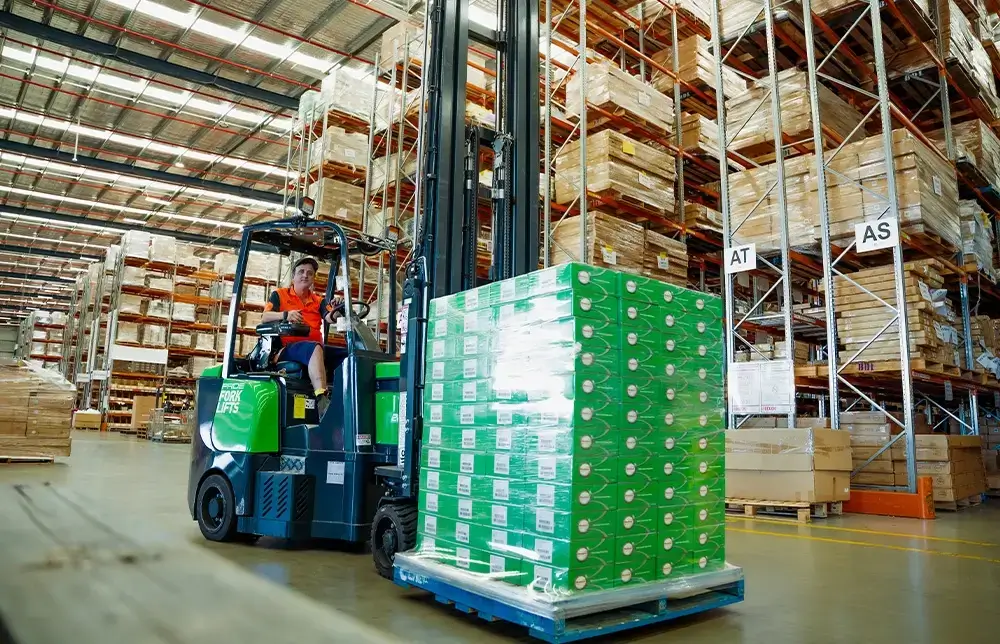
Ask anyone who has tried to send a lounge suite, a treadmill or an industrial pump across the country and they will describe the same frustration. The moment a product outgrows a standard carton, the ordinary rules of freight stop applying. Parcel networks that shift millions of small packages without blinking suddenly hesitate, surcharges appear without warning, and the risk of damage climbs with every extra handover. This is the territory of big and bulky logistics, and it runs on a logic entirely its own.
What is big and bulky logistics?
Big and bulky logistics is the warehousing, handling and delivery of oversized, heavy or awkwardly shaped goods that sit outside the limits of standard parcel freight. The category covers furniture, mattresses, whitegoods, fitness equipment, outdoor settings, building materials and industrial machinery. Because these items cannot travel along the conveyor driven networks built for small packages, they rely on industrial grade racking, reinforced flooring, forklifts and specialist carriers to move safely and without ruining margins.
It is best understood as a distinct discipline rather than a heavier version of ordinary fulfilment, with its own equipment, skills and risks. Operators that focus on this work, offering specialist big and bulky 3PL services, build their entire facility and fleet around these demands rather than retrofitting a parcel operation to cope.
What counts as a big and bulky item?
There is no single national definition, but most operators apply a practical test based on size, weight and shape. As a rule of thumb, an item starts to behave like big and bulky freight once it passes roughly 25 kilograms, exceeds about a metre in any dimension, or simply cannot be lifted comfortably by one person. Weight alone is not the whole story. A long, light flat pack wardrobe can be just as difficult to move as a dense slab of stone, because awkward shape and length create their own handling problems.
In everyday retail terms, the category includes sofas and bed frames, fridges and washing machines, treadmills and weight racks, barbecues and outdoor lounges, and the building products and machinery that keep trades and factories running. A simple field test holds up well. If a customer would expect two people to carry it through a doorway, it belongs in the big and bulky world.
Why standard parcel logistics breaks down
Parcel carriers are engineering marvels of a particular kind. They are built to move enormous volumes of small, uniform packages through automated sortation hubs at speed. Oversized goods break that model at every point. They do not fit the conveyors and chutes, they cannot be sorted by machine, they often need a team of two to lift, and they ride in vehicles fitted with tail lifts rather than the standard vans of a courier round. The damage risk is also far higher, because a heavy item with a hard edge can wreck both itself and everything around it.
Faced with all of this, most parcel networks either decline oversized freight outright or accept it with steep surcharges and little accountability for the outcome. Specialist big and bulky carriers exist precisely to fill that gap, with the equipment, training and vehicles the work genuinely demands. B dynamic Logistics runs exactly this kind of dedicated big and bulky division, built specifically to handle the freight standard parcel networks turn away.
How oversized goods are handled, step by step
The handling sequence for a bulky item looks deceptively similar to any other order, but each stage carries extra weight, quite literally.
- Goods are received with mechanical aids and trained teams rather than a single worker and a trolley.
- They are stored on racking rated for their weight, on floors built to carry the load, with enough clearance for forklifts to operate safely.
- When an order is picked, staff follow documented handling procedures designed to protect both the product and the people moving it.
- Packaging is matched to the shape of the item, not forced into a generic box.
- Dispatch is planned around vehicles that can carry the dimensions involved, and final delivery is often completed by a team of two who place the item inside the customer’s home rather than leaving it at the kerb.
The single most important principle running through all of this is touch reduction. Every additional handover is a fresh chance for an awkward, heavy item to be dropped, scuffed or damaged, so the strongest operations are designed to move each item as few times as possible. B dynamic Logistics’ big and bulky division is built around this principle, with trained teams and dedicated infrastructure designed to keep handovers to a minimum at every stage.
The infrastructure a serious operation needs
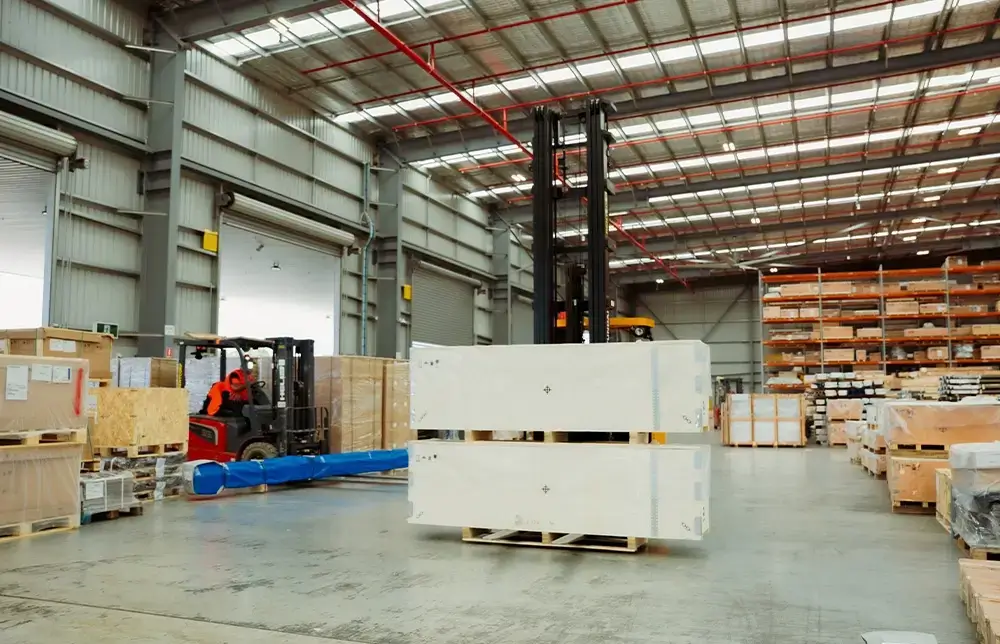
Behind a smooth bulky delivery sits a surprising amount of fixed infrastructure. A facility handling this work needs generous ceiling height for tall racking and machinery, floor loading capacity well beyond a standard warehouse, and dock heights and door widths that allow large items in and out without a struggle. It needs forklifts, cranes where appropriate, and vehicles fitted for oversized loads. Just as importantly, it needs people trained specifically in moving heavy and awkward goods, and established relationships with the carriers equipped to take that freight across long distances.
Few growing retailers can assemble all of this quickly or cheaply. It is the reason so many turn to a third party logistics service partner that already operates this infrastructure at scale, frequently across several states, rather than tying up their own capital trying to build it from the ground up. A provider running a dedicated bulky division across multiple capital cities can offer immediate access to capacity that would otherwise take years to create. B dynamic Logistics operates exactly this kind of dedicated big and bulky division, with stock positioned across a five-city network in Sydney, Melbourne, Brisbane, Adelaide and Perth.
Manual handling, safety and the cost of getting it wrong
None of this is optional from a safety point of view. Under Australian Work Health and Safety law, employers must manage the risks created by manual handling, including heavy, awkward or repetitive lifting. In practice that means risk assessments, mechanical aids, safe systems of work, and clear procedures for the lifts that genuinely require two people. Safe Work Australia publishes guidance on hazardous manual tasks, and any operator should confirm its current obligations with Safe Work Australia and the relevant state regulator.
The commercial stakes are real. Manual handling injuries are among the most common and most expensive incidents in any warehouse, and their frequency tracks closely with the quality of training and supervision in place. Treating safety as a genuine cost of doing business, rather than an afterthought, is what keeps both people and margins intact. A dedicated B dynamic Logistics account contact can talk through how these obligations are managed day to day, giving retailers confidence their oversized range is being handled safely and compliantly.
The mistakes that catch businesses out
A handful of errors recur whenever a business scales its oversized range. The most common is treating bulky goods like large parcels and assuming a parcel carrier will simply cope. The second is choosing a logistics partner on headline rate alone, only to discover that capability gaps cost far more in damage and failed deliveries later. The third is underestimating returns, which for bulky items are slow, costly and operationally complex. The fourth is ignoring Australia’s geography, and the genuine difficulty of moving large goods between distant capitals. The last is running blind, without real time visibility of where stock and orders actually sit. The BDL Advantage platform is built to close that last gap, giving clients real time visibility of stock and orders across every state served.
Getting it right
Big and bulky logistics rewards specialists. The combination of purpose built facilities, trained handling teams, the right vehicles and a carrier network that reaches across the country is difficult to replicate and expensive to maintain, which is exactly why it creates a durable advantage for the businesses that master it. For retailers and manufacturers weighing how to handle their oversized range, the practical question is rarely whether bulky logistics is hard. It is whether to build that capability internally or to partner with an operator who already runs it at scale across multiple states. Either way, the first step is understanding the discipline for what it truly is. B dynamic Logistics’ cross-sector big and bulky division exists for exactly this reason, and a conversation with a dedicated account contact is a straightforward way to work out whether building this capability internally or partnering makes more sense for a specific product range.
Frequently asked questions
Q1: What is big and bulky logistics?
Big and bulky logistics is the warehousing, handling and delivery of oversized, heavy or awkwardly shaped goods such as furniture, mattresses, whitegoods, fitness equipment and industrial machinery. It relies on industrial grade racking, reinforced flooring, forklifts and specialist carriers, because standard parcel networks cannot store or move these items safely or economically.
Q2: What counts as a big and bulky item in Australia?
An item is generally treated as big and bulky once it exceeds standard parcel limits on weight, length or shape, often beyond roughly 25 kilograms or a metre in any dimension, or whenever it needs two people to move. Furniture, appliances, fitness gear, outdoor settings and building materials are typical examples.
Q3: Why can’t standard couriers deliver large items?
Parcel couriers are built for high volumes of small, uniform packages on automated networks. Oversized goods do not fit that automation, need a team of two and tail lift vehicles, and carry far higher damage risk. Most parcel carriers therefore decline them or apply heavy surcharges, which is why specialist bulky carriers exist.
Q4: What equipment is needed to store big and bulky stock?
A compliant operation needs racking rated for heavy loads, reinforced flooring, generous ceiling height, suitable dock heights and door widths, and handling equipment such as forklifts and, where relevant, cranes. Trained teams and documented procedures matter just as much as the machinery itself.
Q5: How do you reduce damage to bulky goods in transit?
Damage falls when items are stored on rated racking, handled by trained staff using correct equipment, packaged for their shape, and carried on vehicles built for oversized freight. The biggest lever is touch reduction, because every extra handover is another chance for a heavy, awkward item to be damaged.
Q6: What are the manual handling rules for heavy items in Australia?
Australian Work Health and Safety law requires employers to manage manual handling risks from heavy, awkward or repetitive lifting through training, mechanical aids and safe procedures. For bulky operations this includes documented two person lift protocols. Always confirm current obligations with Safe Work Australia and your state regulator.
Q7: What is two person delivery?
Two person delivery uses a team of two to safely move a heavy or awkward item into a customer’s home, often including placement in the room of choice, unpacking or basic assembly. It is standard for furniture, large appliances and fitness equipment, both to protect the goods and to meet safe handling obligations.
Q8: Is big and bulky logistics more expensive than standard freight?
Per item it usually costs more, because the goods need specialist storage, handling and vehicles, and often a delivery team of two. The right comparison, however, is total cost across storage, handling, freight and returns, since avoiding damage and failed deliveries often makes a specialist the cheaper option overall.
Q9: When should a retailer outsource bulky fulfilment to a 3PL?
Outsourcing logistics makes sense when order volume strains your space and labour, when damage or failed deliveries are rising, when peak periods overwhelm you, or when building compliant infrastructure would tie up capital better spent on product and marketing. If two or more of these apply, a specialist 3PL is worth modelling. A dedicated B dynamic Logistics account contact can help model the numbers against an existing operation.
Q10: What is the difference between a parcel carrier and a specialist bulky carrier?
A parcel carrier moves small, uniform packages through automated hubs at speed. A specialist bulky carrier handles oversized, heavy freight with tail lift vehicles, trained teams and procedures suited to awkward loads. The two networks rarely overlap, which is why oversized goods need a carrier chosen for the task.
Q11: How are bulky goods returns handled?
Bulky returns are collected by a delivery team or specialist vehicle, transported back over distance, inspected, and then restocked, repaired or written off. Because these items cannot be dropped at a network point, returns are slow and costly, so they are best designed into the operation from the start rather than treated as an afterthought.
Q12: Which Australian cities can big and bulky goods be delivered to?
Oversized goods can be delivered nationally, though cost and transit time depend heavily on distance. Networks with warehousing in Sydney, Melbourne, Brisbane, Adelaide and Perth can position stock close to demand, which shortens delivery times and reduces interstate freight cost across both metro and regional areas. B dynamic Logistics operates exactly this five-city network, with dedicated big and bulky stock positioned in each state to support both metro and regional delivery.
Q13: What industries rely most on big and bulky logistics?
Furniture and homewares, whitegoods and appliances, fitness equipment, outdoor and barbecue brands, building materials suppliers and industrial machinery makers all depend on big and bulky logistics. Growing ecommerce sellers in these categories are among the fastest adopters, since their oversized stock quickly outgrows a standard warehouse.
Back to Blog